Houthi Advance to Bab el-Mandeb: How the Yemen War Became a Global Oil and Shipping Crisis
By: News Desk | 17 September 2026
Sana’a/Riyadh: A war that began as a struggle for power inside Yemen is once again spilling far beyond the country’s borders.
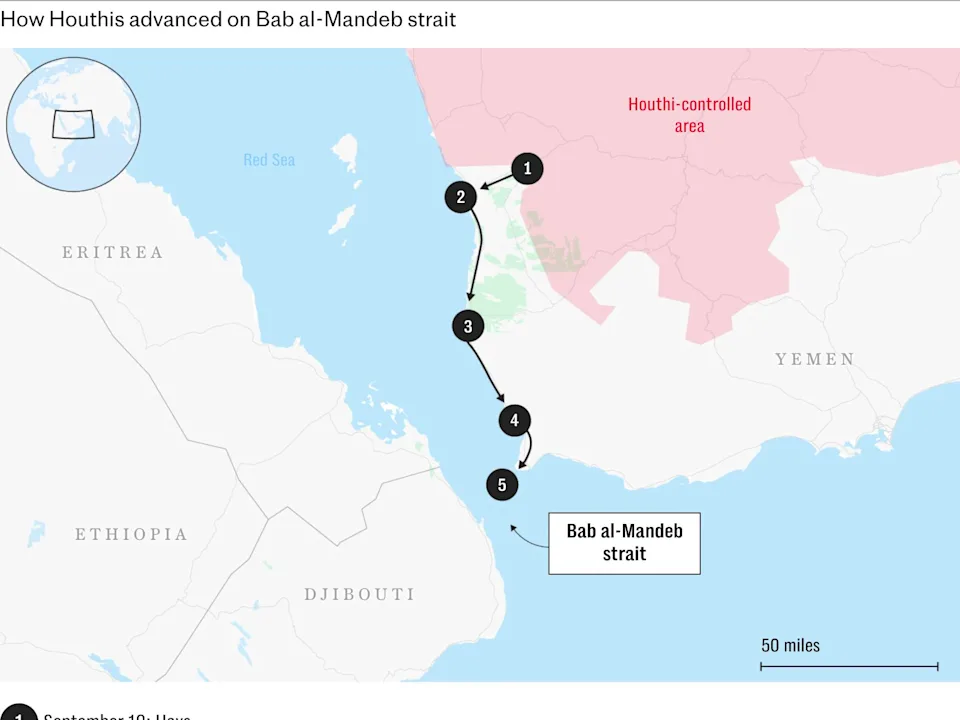
In the space of little more than a week, Iran-aligned Houthi forces have seized the strategic Red Sea port city of Mocha, advanced onto important islands including Mayun and the Hanish Islands, and moved closer to the Bab el-Mandeb Strait, one of the world’s most important maritime chokepoints.
The change is significant.
For years, the Houthis have demonstrated their ability to fire missiles and drones at Saudi Arabia and threaten commercial shipping. Their latest territorial gains give them something different: physical positions on Yemen’s Red Sea coastline from which they can potentially exert sustained pressure on maritime traffic.
Reuters reported that Houthi forces captured Mocha on September 10 and subsequently reached the Hanish Islands, describing the advance as a dramatic strategic shift that could threaten the Bab el-Mandeb.
The consequences are already being felt in Saudi Arabia and international energy markets.
Oil has remained above $100 a barrel, Saudi Arabia has suffered disruptions to alternative oil-export routes, and shipping companies face the possibility that a maritime corridor already weakened by years of Houthi attacks could become even more difficult and expensive to use.
But there is an important distinction.
The Houthis have advanced to and around the Bab el-Mandeb region. That does not mean that every vessel has stopped transiting the strait.
Reuters data showed that 23 commodity vessels crossed the Bab el-Mandeb on September 17, compared with a 10-day average of around 26. The traffic is therefore under pressure, but the waterway has not become completely closed.
That distinction may prove crucial for the global economy.
Mocha: the capture that changed the map
Mocha, historically known for the coffee trade that took its name from the city, sits on Yemen’s western coast close to the southern entrance to the Red Sea.
Its military importance is far greater than its commercial size.
The port lies less than 50 miles from Bab el-Mandeb and provides the Houthis with a strategic position overlooking one of the principal approaches to the Red Sea. Reuters reported that Houthi forces took the city after government forces failed to stop their advance.
The capture also changed the geography of the war.
Previously, Houthi pressure on shipping was primarily based on missile, drone and naval capabilities.
Now the group has expanded its territorial footprint along the coastline.
That creates the possibility of sustained surveillance, coastal missile operations, drone launches and pressure on vessels travelling through the southern Red Sea.
It does not automatically give the Houthis the ability to physically close Bab el-Mandeb.
But it increases their capacity to threaten it.
The islands add another layer of leverage
The next development was even more strategically sensitive.
Houthi forces moved onto islands in the Red Sea, including Mayun, also known as Perim, which sits directly in the Bab el-Mandeb waterway, while reports also indicated a Houthi advance into the Hanish Islands.
The geography matters.
Mayun divides the strait into two navigable channels and sits close to the main maritime route between the Red Sea and Gulf of Aden.
The Hanish Islands, farther north, provide additional positions in the Red Sea.
Reuters reported the Houthi movement onto Hanish after the capture of Mocha.
The combination of coastal territory and island positions is therefore more consequential than the capture of an isolated town.
It potentially gives the Houthis a chain of locations from which they can monitor and threaten maritime movement.
Bab el-Mandeb is not just another waterway
Bab el-Mandeb connects the Red Sea with the Gulf of Aden and the wider Indian Ocean.
At its northern end lies the route toward the Suez Canal.
For decades, it has served as one of the principal maritime bridges between Asia, the Middle East and Europe.
The Associated Press estimates that about 12% of global trade passes through the corridor in normal circumstances.
But the figure needs context.
The Red Sea shipping system has already been severely disrupted by the Houthi campaign that began in late 2023.
AP reported that Red Sea shipping had fallen by roughly 60% from previous levels as commercial vessels avoided the route because of attack risks.
In other words, the current crisis is not threatening a perfectly normal shipping corridor.
It is threatening a route that has already been operating below capacity.
That makes the latest territorial gains particularly important.
The real danger is not a blockade. It is uncertainty.
The greatest economic damage may occur even without a formal Houthi blockade.
Shipping companies do not need to be physically prevented from entering a waterway before they begin avoiding it.
If insurers raise premiums, if vessels require additional naval escorts, if crews face higher risks or if companies expect attacks, operators can choose longer routes.
That creates higher fuel consumption, longer delivery times and greater freight costs.
The experience since 2023 demonstrated exactly this mechanism.
Ships avoiding the Red Sea have frequently been forced to travel around the Cape of Good Hope, adding thousands of kilometres to Asia-Europe journeys.
The latest Houthi advance threatens to reinforce that pattern.
Saudi Arabia faces a particularly difficult problem
For Riyadh, the timing could hardly be worse.
Saudi Arabia has been relying increasingly on routes through the Red Sea to move oil toward international markets while the wider regional conflict has disrupted the Strait of Hormuz.
Its East-West pipeline, running roughly 1,200 kilometres from the kingdom’s eastern oil fields to the Red Sea, is strategically important because it provides an alternative to transporting crude through Hormuz.
But that alternative has itself been disrupted.
Saudi Arabia temporarily shut the pipeline after a drone attack that caused damage and injuries. Reuters reported that the pipeline normally transports around 4-5 million barrels of oil per day and had become especially important because Hormuz was severely disrupted.
The result is a strategic squeeze.
Saudi Arabia needs the Red Sea route precisely when the Red Sea is becoming more dangerous.
Oil markets are already responding
The energy consequences have not remained confined to the Middle East.
Oil prices have remained above $100 a barrel as traders assess attacks on Saudi infrastructure, disruptions around the Red Sea and the wider regional conflict.
On September 15, Brent crude rose about $3 after shipping sources reported that crude loadings at Saudi Arabia’s Red Sea export hub of Yanbu had been suspended and Riyadh had cancelled some European cargo deliveries.
Prices subsequently eased somewhat, but Brent remained above $100 on September 17 as investors weighed the possibility of additional Saudi supplies against continuing attacks and infrastructure disruptions.
This illustrates an important feature of the present crisis.
The market does not need Saudi Arabia to lose all of its production for prices to rise.
It only needs uncertainty about how much oil can actually reach international customers, through which routes and at what cost.
Why the Houthis are focusing on the coast
The Houthi strategy appears increasingly connected to economic pressure.
Their missile and drone attacks against Saudi Arabia have targeted energy infrastructure, while their maritime campaign has sought to make the Red Sea costly and dangerous for vessels associated with their opponents.
The territorial advance adds another dimension.
Instead of relying exclusively on weapons launched from distant positions, the Houthis can now potentially use territory along the coast to support their maritime strategy.
Reuters described the capture of Yemen’s Red Sea coastline as a development that is reshaping the regional balance of power and strengthening Iran’s position.
That does not mean Iran directly controls every Houthi military decision.
The Houthis remain a Yemeni armed movement with their own political and military interests.
But their relationship with Tehran has given them access to technology, training and strategic support, while the current regional conflict has increased the value of their position on the Red Sea.
Saudi Arabia is being forced to fight on several fronts
The kingdom’s security challenge now stretches across multiple domains.
There is the direct threat from Houthi missiles and drones.
There is the security of oil fields, refineries and pipelines.
There is maritime security along the Red Sea.
There is the protection of the airspace around major cities and religious sites.
And there is the diplomatic challenge of preventing the Yemen war from merging completely with the wider Iran-US confrontation.
The recent Houthi drone incident near Mecca has added an extraordinary symbolic dimension.
Saudi authorities said their air defences intercepted a Houthi drone south of Mecca. The Houthis denied deliberately targeting the holy city.
The Organisation of Islamic Cooperation condemned attacks threatening Saudi territory and the sanctity of Islamic holy sites.
The episode demonstrated how rapidly a military incident can become a religious and diplomatic crisis.
The humanitarian cost is becoming harder to ignore
The international focus on oil and shipping risks obscuring what is happening inside Yemen.
The renewed fighting has displaced large numbers of civilians.
AP reported that approximately 125,000 people had been displaced by the latest escalation, while UN reporting has documented new population movements toward neighbouring countries as fighting intensified.
The humanitarian consequences extend beyond displacement.
Yemen has already endured years of economic collapse, damaged infrastructure, food insecurity and weakened healthcare.
A new round of fighting along the western coast threatens communities that have experienced repeated cycles of war.
The Red Sea is therefore simultaneously an international shipping corridor and a densely populated humanitarian theatre.
Egypt has much at stake
Egypt is one of the countries most exposed to prolonged disruption.
The Suez Canal is a major source of foreign currency for Cairo, and prolonged weakness in Red Sea shipping reduces the number of vessels reaching the canal.
That is why Egypt has strong economic and strategic reasons to support Red Sea security.
Saudi Crown Prince Mohammed bin Salman has already sought Egyptian support as Riyadh confronts the latest Houthi escalation.
The two countries share an interest in preventing the Red Sea from becoming another permanently militarised maritime theatre.
For Cairo, the issue is not simply Saudi security.
It is the future of one of the world’s most important commercial routes.
The UAE and Gulf states face another calculation
The United Arab Emirates has extensive maritime interests and has historically played a major role in the southern Yemen conflict.
Other Gulf states also have an interest in ensuring that the Houthis do not turn their territorial gains into permanent control over maritime routes.
Yet direct military intervention carries risks.
The experience of the Yemen war since 2015 demonstrated how difficult it is to translate military superiority into a durable political settlement.
The present regional environment is even more complicated because the confrontation with Iran has expanded simultaneously across the Gulf.
That is why Gulf governments face an uncomfortable choice between military deterrence and diplomatic accommodation.
Reuters described precisely this dilemma following the Houthi territorial advance: regional states may have to choose between absorbing growing costs and seeking some form of accommodation with Tehran.
America faces a difficult strategic decision
Washington also faces a complicated calculation.
The United States has a longstanding interest in keeping international shipping lanes open.
But the present regional crisis has already stretched American military resources between the Gulf, the Strait of Hormuz and other theatres.
The Houthi advance toward Bab el-Mandeb creates pressure for the United States to protect maritime traffic.
At the same time, direct intervention against Houthi territory could expand the war.
Reuters reported that U.S. officials recently held talks with Houthi representatives in Oman, highlighting the parallel diplomatic track even as fighting intensified.
That juxtaposition is revealing.
Military deterrence and diplomacy are now operating simultaneously.
Is Bab el-Mandeb actually under Houthi control?
This is perhaps the most important question to phrase correctly.
The Houthis have captured Mocha and moved onto strategically important islands around the southern Red Sea.
They have significantly strengthened their position around Bab el-Mandeb.
Some reporting describes the movement as a seizure of the strait itself.
But maritime traffic data shows that commercial vessels are still passing through.
On September 17, 23 commodity vessels crossed Bab el-Mandeb, compared with an approximately 26-vessel 10-day average.
Therefore, the most accurate description is:
The Houthis have established a significantly stronger military position around Bab el-Mandeb and can threaten the route, but the strait has not ceased functioning as an international waterway.
That distinction matters for markets, governments and shipping companies.
The strategic picture is changing
The capture of Mocha is important not because the port itself is a major global trading hub.
It is important because of what its location allows.
Add Mocha to Mayun, the Hanish Islands, the wider western coastline and the Houthis’ established missile and drone capabilities, and the movement begins to look like an attempt to build a strategic corridor along the Red Sea.
The Institute for the Study of War has assessed that the Houthis are setting conditions for the Bab el-Mandeb to become a waterway under the influence of Iran-aligned forces.
That assessment remains analytical rather than a confirmed declaration of Houthi policy.
But it highlights the central strategic concern.
The issue is no longer simply whether the Houthis can fire a missile at a ship.
It is whether they can build enough territorial, technological and political leverage to make international shipping operators permanently account for Houthi power when planning routes through the Red Sea.
A new kind of Yemen crisis
The Yemen conflict has entered another phase.
The earlier war was largely about territory, government control and the Saudi-Iranian regional rivalry.
The latest phase connects Yemen directly to the world’s maritime economy.
A port has fallen.
Islands have changed hands.
Saudi oil infrastructure has been attacked.
An alternative pipeline route has been disrupted.
Oil prices have climbed.
Shipping traffic is being watched more closely.
And the world’s major powers are once again debating whether to intervene militarily or seek negotiations.
The conflict is no longer geographically contained.
What happens next?
The immediate question is whether the Houthi advance continues southward and consolidates positions around Bab el-Mandeb.
The second is whether Saudi Arabia can restore reliable Red Sea oil-export capacity.
The third is whether international shipping companies decide that the risk has become too high to justify using the Red Sea.
And the fourth is diplomatic.
Can Oman, Saudi Arabia, Egypt, the United States and other regional actors create a channel capable of separating the Yemen conflict from the wider Iran confrontation?
The answer could determine whether the present crisis becomes another temporary disruption or a structural change in global shipping.
The wider lesson
The most important consequence of the Houthi advance is not that one Yemeni port has changed hands.
It is that control of territory, maritime routes and energy infrastructure are now converging in the same conflict.
Mocha places the Houthis close to Bab el-Mandeb.
Mayun and the Hanish Islands give them strategically valuable positions in the Red Sea.
Saudi oil infrastructure is under pressure.
And global markets are already pricing the possibility that the disruption will last.
Yet the situation should not be described as a complete closure of Bab el-Mandeb. Ships continue to pass through the strait, although traffic is under pressure and the strategic risk is considerably higher.
That may be the most important distinction of all.
The global economy does not need a formal blockade to feel the consequences.
If a maritime route becomes sufficiently dangerous, expensive or unpredictable, the market can begin treating it as disrupted long before the last ship stops sailing.
That is the real significance of the Houthi advance.
The Yemen war is no longer merely threatening Saudi Arabia.
It is testing the resilience of one of the world’s most important connections between Asian factories, Middle Eastern energy and European markets.